
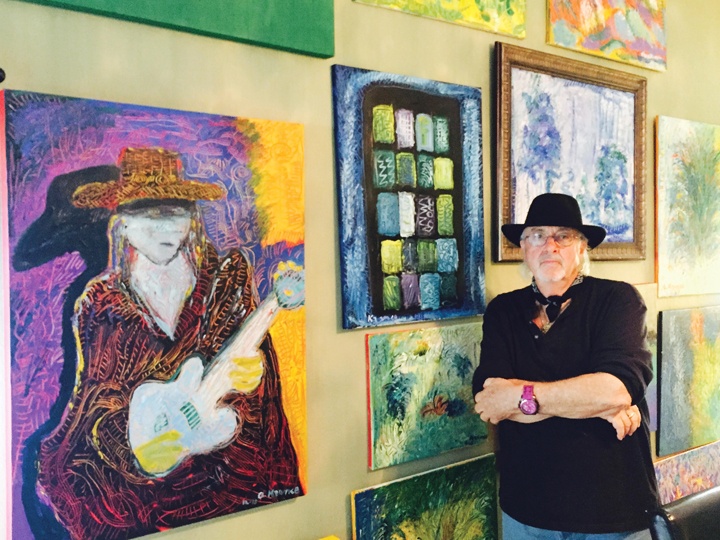
Andrew Krance has spent a lifetime immersed in art..
Born and raised in and around New York City, Andrew was exposed early to the museums, galleries, and artists that made New York one of the world's great cultural centers. Those experiences shaped a lifelong appreciation for artistic expression across many styles—from Impressionism and Surrealism to Cubism and contemporary art.
As Andrew often says:
"Art is deeply personal. You don't always know why a particular painting speaks to you—you simply know when it does."
Andrew earned his Master of Fine Arts (MFA) from the University of Wisconsin–Madison. Although he is also an accomplished musician, painting became the medium through which he could most fully express his imagination, curiosity, and lifelong fascination with color, composition, and emotion.
Early in his career, Andrew returned to New York City, where he lived on Manhattan's Upper East Side. While working for renowned opera singer Dorothy Maynor at the Harlem School for the Arts, he entered an extraordinary circle of artists, collectors, and cultural leaders.
Among the people who profoundly influenced his artistic journey was Barbara Piasecka Johnson, one of the world's most celebrated collectors of fine art. Through her mentorship, Andrew experienced masterpieces by artists such as Van Gogh, Rembrandt, and Monet firsthand and gained invaluable insight into the world of serious art collecting.
Barbara Johnson also introduced Andrew to many influential figures in the art world, including legendary art dealer Leo Castelli, whose gallery helped define postwar American art by representing artists such as Robert Rauschenberg, Jasper Johns, Roy Lichtenstein, and Andy Warhol. Spending time among these artists and creative thinkers gave Andrew a unique perspective on both the artistic process and the contemporary art market.
Today, Andrew works from his studio in Wesley Chapel, Florida, where he continues to create original paintings spanning multiple styles and subjects. Rather than limiting himself to a single genre, he allows each painting to evolve naturally, whether inspired by landscapes, abstraction, imagination, or emotion.
Every painting is an original. Each is created to stand on its own and to form a personal connection with the viewer.
Andrew believes the finest artwork is not chosen simply to match a room—it is chosen because it moves the person who lives with it. His hope is that each painting finds a home with someone who experiences that immediate and unmistakable connection.
"The right painting doesn't just decorate a space. It becomes part of the life lived within it."